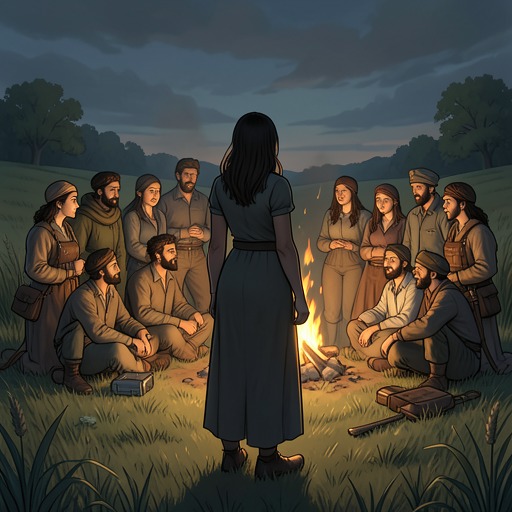
Susan Pevensie
The Last BattleSusan Pevensie, once Queen Susan and a friend of Narnia, is conspicuously absent when Tirian meets the survivors in Aslan’s country. Her absence becomes a brief but consequential reckoning: Peter says she is no longer a friend of Narnia, while Eustace and Jill describe how she dismisses their memories as childish play. The scene gives no account of Susan’s present life beyond those reports, but it makes clear that the others understand her withdrawal as a rupture between shared experience and adult identity.
Identity and Absence
Tirian recognizes that the company before him does not include every member of the royal family he remembers from Narnia’s chronicles. After greeting Peter, Edmund, Lucy, and Polly, he asks whether Peter has two sisters and where Queen Susan is. The question treats Susan not as an incidental omission but as someone whose place in Narnian history ought to be accounted for. Her title and remembered connection to Narnia make her absence especially striking among companions reunited in Aslan’s country.
Peter answers briefly and gravely that Susan is no longer a friend of Narnia. His restraint gives the statement the force of a settled estrangement, though the scene does not explain precisely when or how it began. Susan is not present to describe her own position, so the reader encounters her through the judgments and memories of those who remain. That limitation matters: her rejection is clearly reported, but the scene does not disclose her private thoughts or establish what may happen to her afterward.
How Susan Explains Narnia Away
Eustace supplies the clearest account of Susan’s response when others try to speak with her about Narnia. She calls their recollections wonderful and asks them to imagine that they still think about the funny games they played as children. The phrase reduces a world that the others remember as real to make-believe shared in childhood. Susan’s distance is therefore not described simply as forgetting; as Eustace tells it, she actively recasts their memories as games and their continued attachment as childish persistence.
Jill adds that Susan is now interested in nylons, lipstick, and invitations, and says that Susan had always been much too eager to be grown-up. These details make the reported change concrete without showing Susan in a scene of her own: the everyday objects and social engagements named by Jill stand in contrast to the extraordinary experiences that the others still regard as part of their lives. Jill’s account is sharply critical, however, and belongs to a conversation among people who remain committed to Narnia. It reveals their interpretation of Susan’s priorities rather than offering an independent portrait of her daily life.
The Argument About Growing Up
Polly turns the accusation of immaturity back on Susan. She argues that Susan wasted her school years wishing to be the age she is now and will waste the rest of her life trying to remain at that age. In Polly’s view, Susan has mistaken being grown-up for reaching a particular stage and holding onto it, rushing toward what Polly calls the silliest time of life and then trying to stop there. The judgment sharpens the disagreement: Susan treats the others’ Narnian memories as evidence that they have failed to grow up, while Polly sees Susan’s fixation on adult appearance and status as a failure to grow at all.
The conversation does not resolve that disagreement. Peter stops it, saying they should not talk about the matter now, and directs the company’s attention to the fruit trees. The shift from Susan’s absence to the immediate surroundings closes off any further discussion in the scene. It also leaves the reader with competing assessments rather than a narrated explanation from Susan herself: Peter’s grave declaration, Eustace’s recollection of her dismissive words, Jill’s list of interests, and Polly’s critique together define the group’s sense of loss, but not the full story of Susan’s life.
Narrative Significance and Unresolved Future
Susan’s estrangement creates a contrast between the companions’ shared past and their present reunion. Tirian’s question begins with the expectation that the family and its history belong together; Peter’s answer makes clear that the expected unity no longer holds. The scene then develops that absence through increasingly pointed testimony, moving from Peter’s concise statement to Eustace’s account of Susan’s dismissal, Jill’s criticism of her interests, and Polly’s broader judgment about maturity. Susan never enters the conversation, and the change of subject prevents the gathering from turning into a fuller inquiry.
The result is deliberately limited but consequential characterization. Susan is associated with the loss of belief in Narnia and with an idea of adulthood that her companions regard as shallow or arrested. Yet the evidence here is entirely retrospective and filtered through others who disagree with her; it does not show her making a new choice, establish whether she can return to Narnia, or determine her eventual fate. Her unresolved absence keeps the final reunion from being complete and leaves the boundary between remembered childhood and continued attachment to Narnia at the center of the scene.